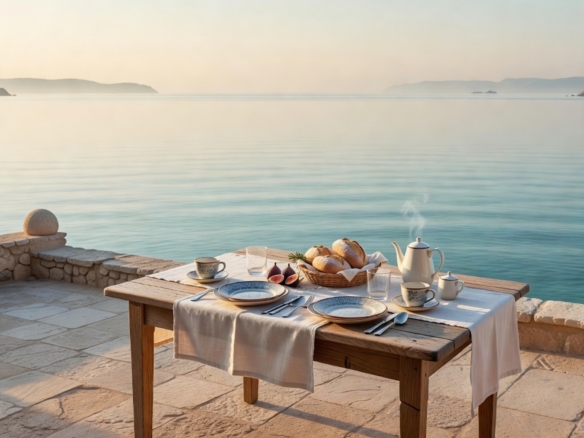
What a Cretan coastal home can teach us about stone, timber, shade and interiors that belong to their surroundings.
There is a particular kind of coastal interior that barely needs to announce where it is. No collection of blue-and-white accessories is required, nor the carefully positioned piece of coral that seems to have become shorthand for living near the sea. The place itself does the work.
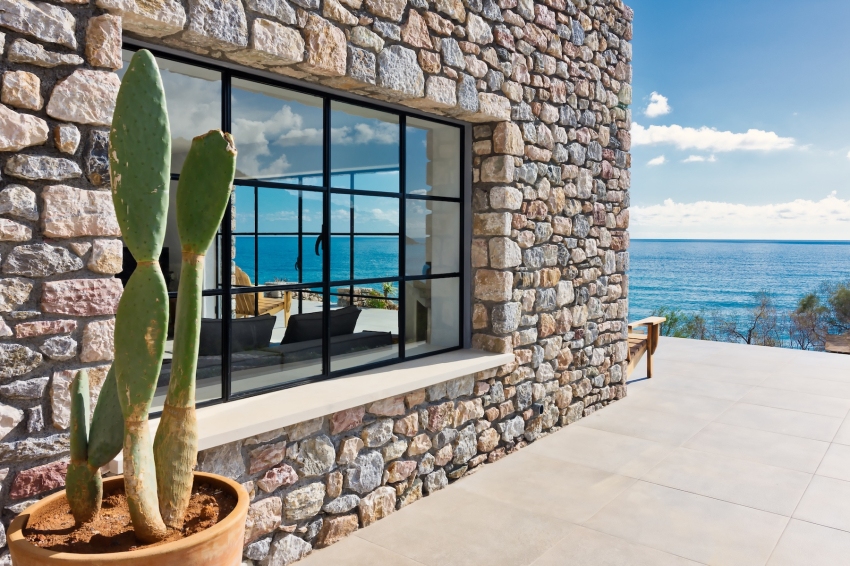
At Arvi West, on the southern coast of Crete, the Mediterranean enters the house in quieter ways. Through rough stone warmed by the sun, substantial timber overhead, pale mineral surfaces and deep areas of shade. Through windows that frame the sea rather than compete with it. And, perhaps most beautifully, through the changing patterns of sunlight cast by timber and reed canopies across tables, walls and floors.
It is an approach to coastal design that feels less like decoration and more like belonging.
Let the architecture provide the decoration
The strongest element of these interiors is not an object at all. It is the material palette.
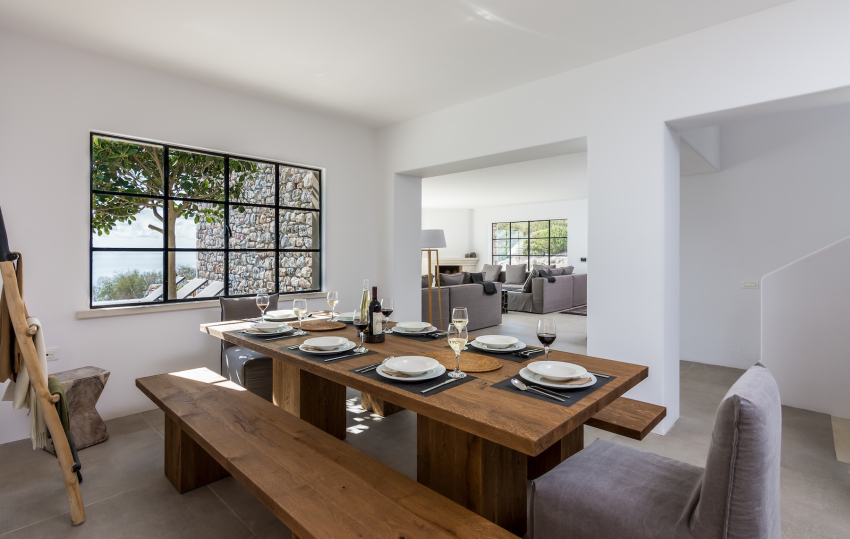
Stone walls and columns have enough variation and texture that they need very little embellishment. Timber beams introduce warmth overhead, while the floors and plastered surfaces remain deliberately restrained. Against them, black steel window frames provide just enough definition.
Nothing appears excessively polished.
That matters. A home beside the Mediterranean has a different relationship with perfection than an urban interior. Sun, salt, heat and outdoor living are part of its character. Materials that can acquire a little patina often feel more appropriate here than surfaces designed to remain immaculate.
The result is a house that can become more convincing with age rather than less.
Shade is part of the interior
In a warm climate, shade is usually discussed as a practical necessity. Architecturally, however, it can be much more interesting than that.
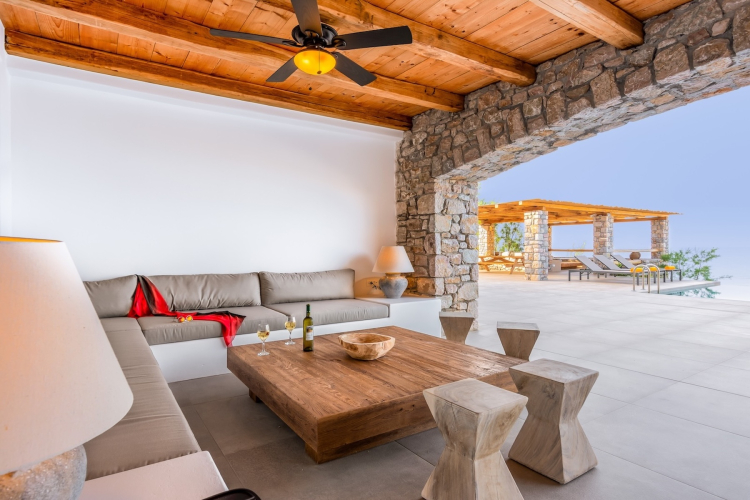
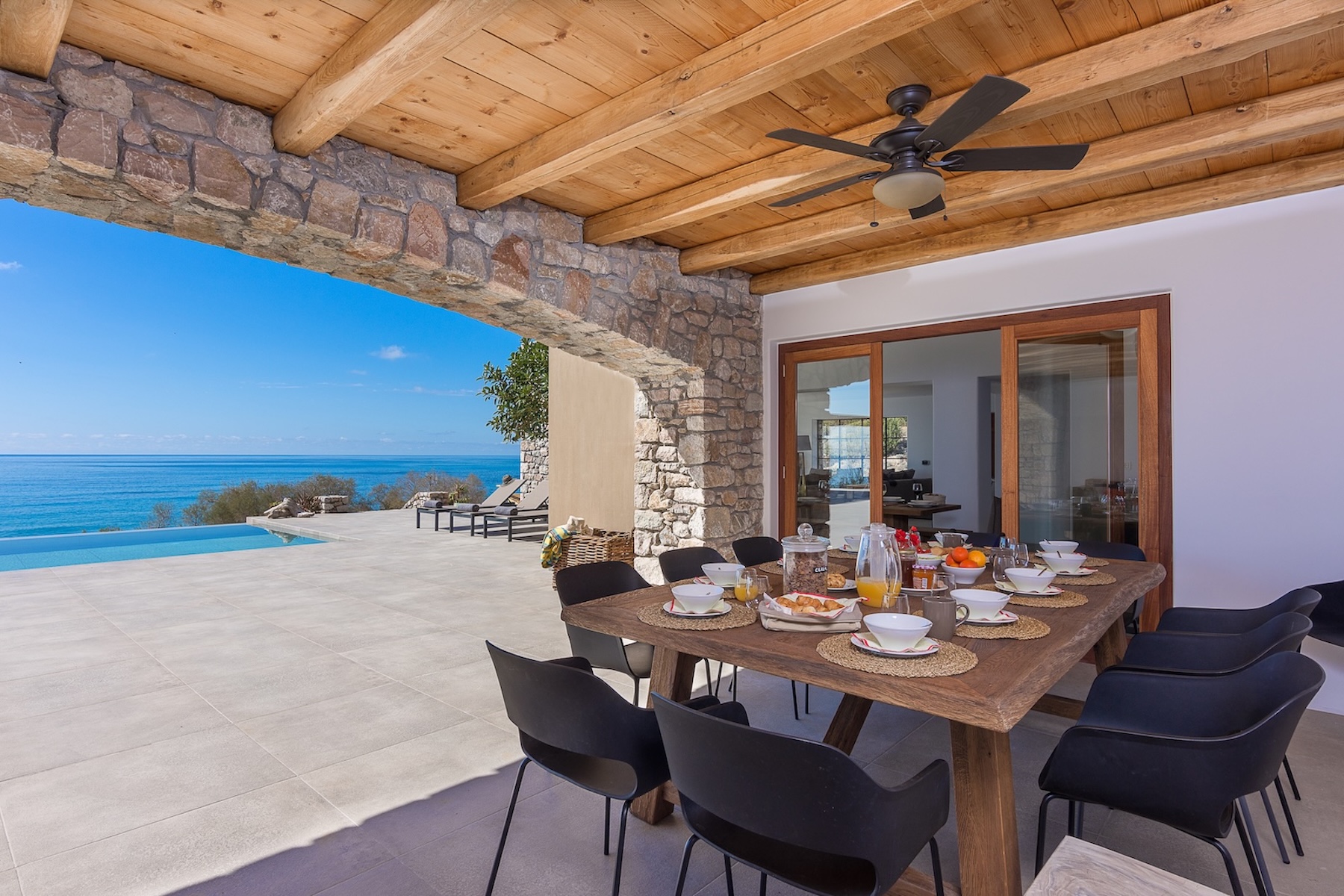
The covered terraces at Arvi West effectively become outdoor rooms. Heavy timber structures establish their proportions while reed ceilings soften the sunlight before it reaches the spaces below. The effect changes constantly during the day.
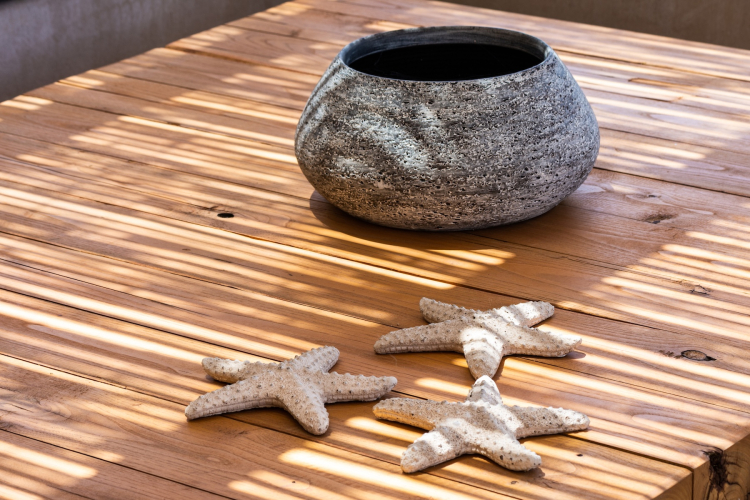
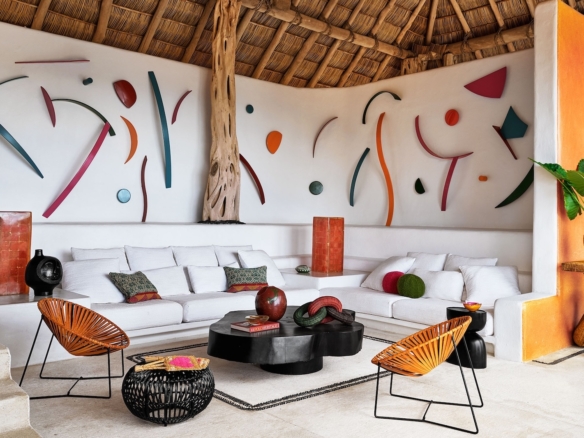
Look closely at the smaller details — the ceramic vessel on the timber table, the shell-like sculpture, the simple benches — and the shadows become part of the composition.
This is something worth borrowing from Mediterranean architecture even far beyond Crete: instead of treating daylight simply as something to maximise, consider how it can be filtered.
A room flooded uniformly with light can be beautiful. A room in which light changes, moves and creates contrast can have considerably more atmosphere.
Filtered sunlight becomes part of the interior, changing the character of natural materials throughout the day.
A limited palette allows texture to take over
There is remarkably little colour competing for attention here.
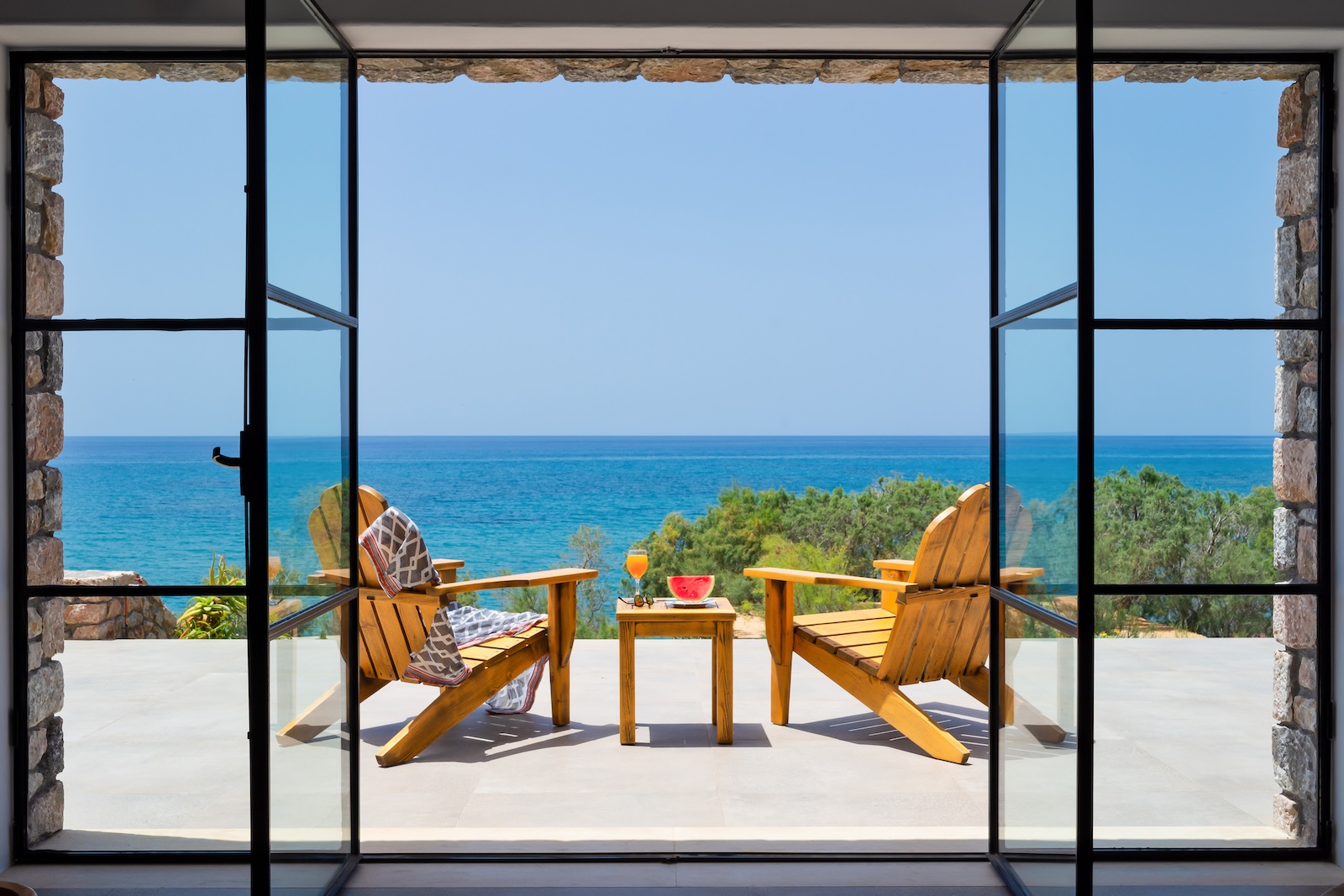
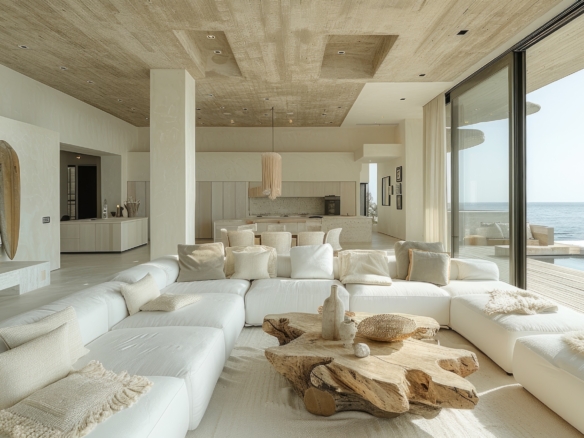
Warm timber, grey stone, soft white walls, muted upholstery and mineral-toned floors establish most of the palette. Against that restraint, small moments of colour — fruit on a table, greenery outside a window, the intensely blue Libyan Sea — suddenly matter.
It is precisely because the interior isn’t trying to reproduce the colours of the coast that the real landscape becomes so powerful.
The lesson is a useful one for coastal interiors generally. Bringing the sea into a house does not necessarily mean borrowing its colour. Sometimes the better decision is to create a quiet background and allow the actual sea to provide the blue.
Rather than bringing coastal colors indoors, the restrained palette allows the sea itself to provide them.
The boundary between inside and outside should become uncertain
Perhaps the most successful spaces at Arvi West are those that are difficult to classify.
Is the large covered living area an interior room or a terrace? Architecturally it belongs to both. The same stone continues through the building. Timber ceilings extend outward. Furniture has the scale and comfort of indoor furniture, yet the entire space remains open to the landscape.
Elsewhere, large steel-framed openings perform the opposite trick. From inside, they turn terraces, trees and the horizon into enormous pieces of living artwork.
This is one of the great advantages of designing a coastal home around how people actually live rather than around a conventional distinction between house and garden.
Breakfast migrates outside. A shaded sofa becomes preferable to the formal living room. Doors remain open. People naturally move toward the breeze, the view or the cooler side of the house.
Good architecture anticipates that behaviour.
The distinction between interior and terrace becomes deliberately less important.
Simplicity needs warmth
Restrained interiors can easily become austere. Arvi West avoids that largely through material contrast.
The architecture is quite disciplined: white walls, grey floors, simple openings and substantial geometric forms. But timber prevents the spaces from becoming clinical. It appears in ceilings, dining tables, benches, doors, window frames and occasional pieces of furniture.
Importantly, it isn’t all identical.
There are variations in grain, tone and finish. Alongside irregular stone and handmade-looking ceramics, those imperfections give the otherwise simple rooms character.
This may be the most transferable idea of all. A calm interior doesn’t require fewer sensations; it requires better ones. The grain of a table, the texture of stone under a hand, the shadow cast through reeds and the coolness of a mineral floor can contribute more to a room than another decorative object ever could.
Materials connect the house to its landscape without trying to imitate it.
Coastal design without the costume
Perhaps that is why Arvi West feels convincingly Mediterranean.
It doesn’t seem to be trying very hard to be Mediterranean.
Its identity comes from climate, landscape and materials rather than symbols. The sea is visible through a window instead of represented on a cushion. Shade is created by timber and reeds rather than added afterwards with an umbrella. Stone feels connected to the landscape surrounding the house.
That distinction is worth remembering when creating any coastal interior.
The most enduring homes near the sea rarely imitate their surroundings. They respond to them.
Experience the house behind the design
The interiors featured in this article belong to Arvi West, part of Beach House Arvi Estate on the unspoiled southern coast of Crete.
It is one of the homes in the CVAY Collection, selected not only for its setting beside the Libyan Sea, but for the way architecture, outdoor living and the landscape come together.
Born in the Netherlands, Heleen Stravers has lived in diverse coastal regions, including the Caribbean, Belgium, and Florida. With over 10 years of experience in selling coastal properties and helping people find their dream homes, Heleen has a wealth of knowledge about waterfront living. She is a former co-owner of real estate offices in both the Caribbean and Florida, where she gained invaluable expertise in coastal markets and developed a strong network within the industry.
Please enter your username or email address. You will receive a link to create a new password via email.
Manage Consent
We use cookies to ensure the website works properly, understand how visitors use CVAY, and support selected features such as maps, videos and social media. You can accept all cookies, decline optional cookies, or manage your preferences.
Functional
Always active
The technical storage or access is strictly necessary for the legitimate purpose of enabling the use of a specific service explicitly requested by the subscriber or user, or for the sole purpose of carrying out the transmission of a communication over an electronic communications network.
Preferences
The technical storage or access is necessary for the legitimate purpose of storing preferences that are not requested by the subscriber or user.
Statistics
The technical storage or access that is used exclusively for statistical purposes.The technical storage or access that is used exclusively for anonymous statistical purposes. Without a subpoena, voluntary compliance on the part of your Internet Service Provider, or additional records from a third party, information stored or retrieved for this purpose alone cannot usually be used to identify you.
Marketing
The technical storage or access is required to create user profiles to send advertising, or to track the user on a website or across several websites for similar marketing purposes.