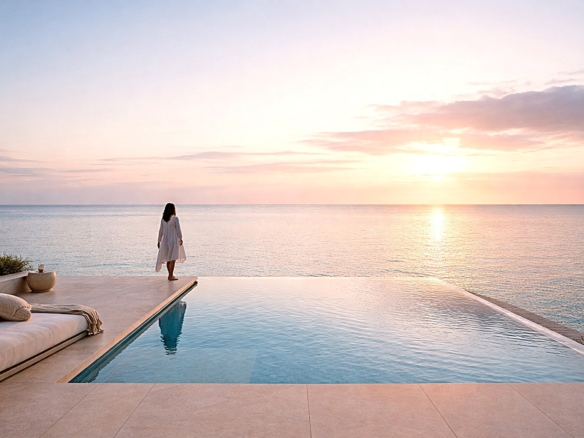
Before salt rooms.
Before wellness design.
Before modern terminology — there was this.
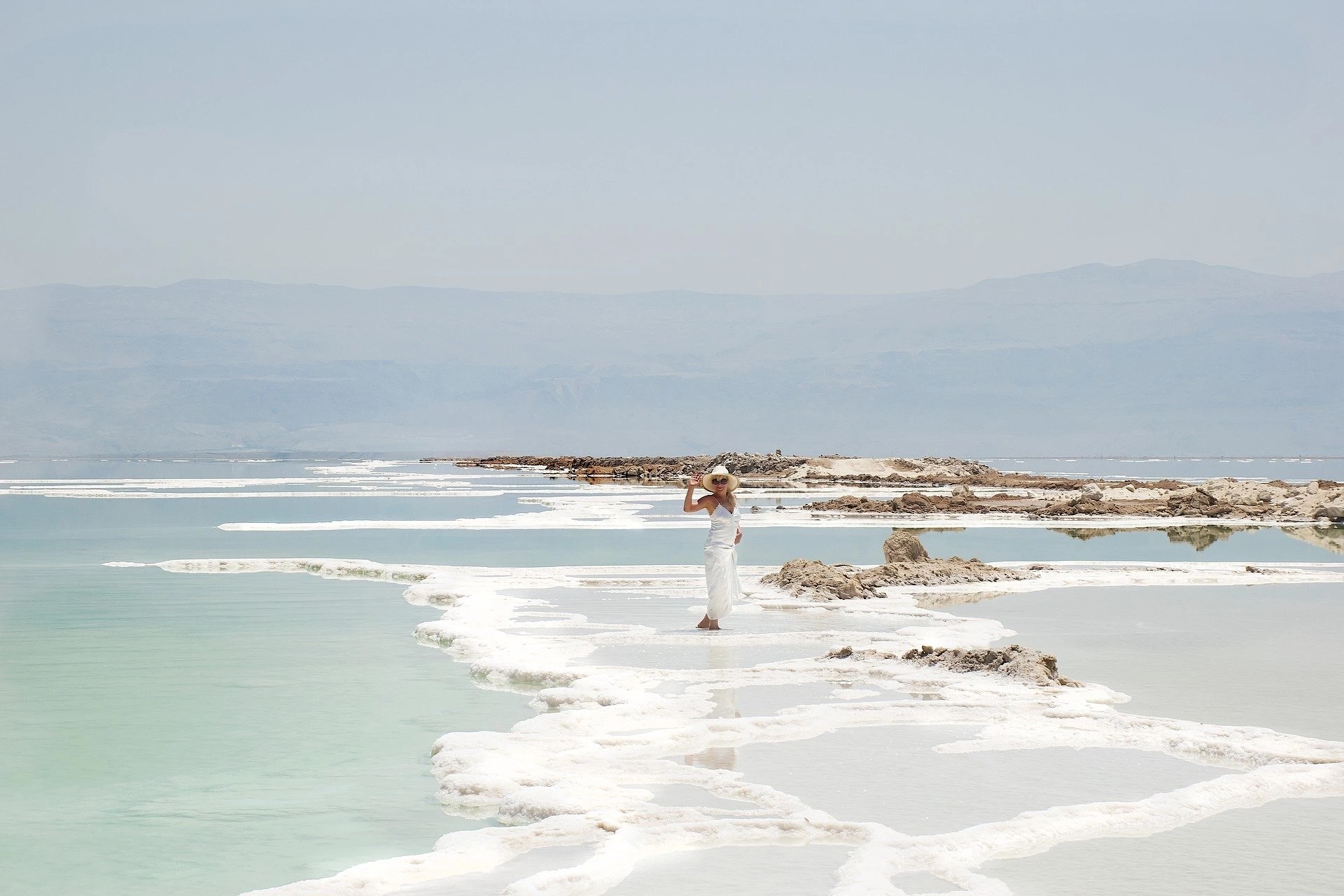
White mineral formations stretching into quiet water.
Air dense with salt.
A horizon that dissolves urgency.
Places like the Dead Sea have drawn seekers for centuries — not for spectacle, but for stillness. The experience is subtle yet profound: breathing deepens, thoughts slow, the body feels lighter.
Neuroscience now describes this state as Blue Mind — the measurable calm our brains enter near water. But long before science named it, civilizations understood that mineral landscapes restore.
What feels contemporary is not the idea of salt as wellness.
What feels contemporary is our desire to bring that atmosphere indoors.
From Mineral Landscape to Architectural Language
Even without the sea in front of you, the same sense of calm can be recreated — though nothing quite replaces the clarity of an open horizon.
Salt is not simply a substance. It is a material shaped by geometry.
Look closely at mineral shores and you notice repetition — crystalline order, cellular patterns, quiet symmetry. Nature builds in structure, not randomness.
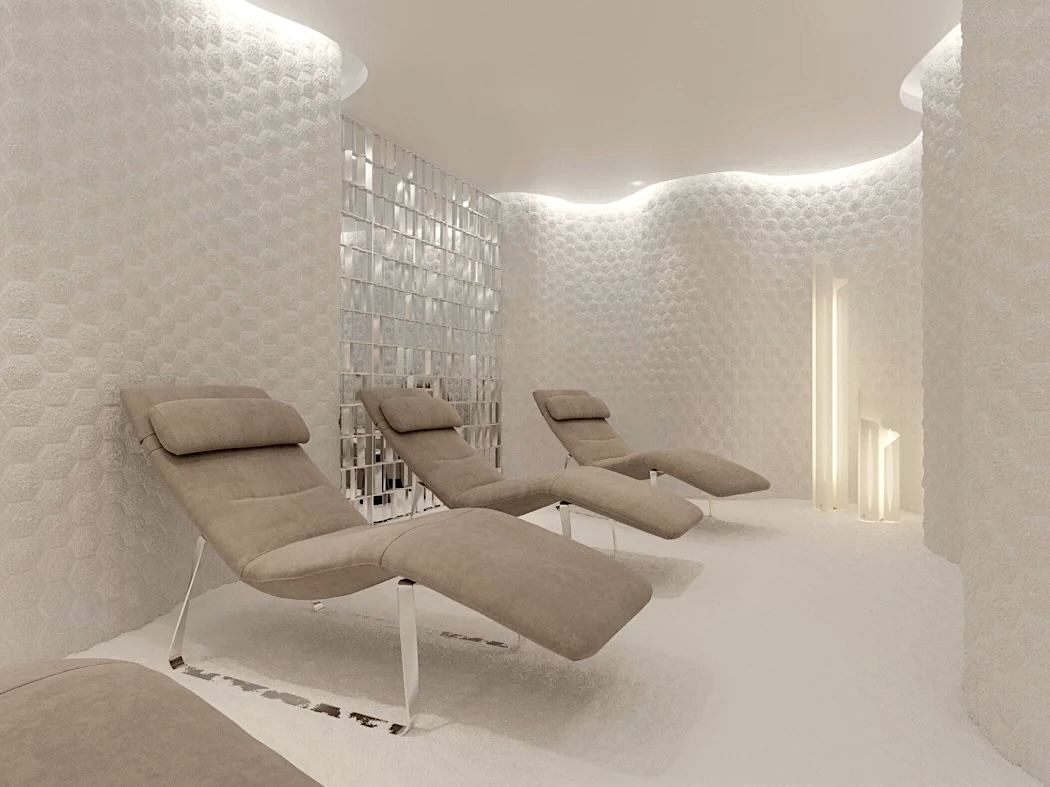
Today, designers are translating that structure into interior spaces. Hexagonal mineral walls, softly illuminated white salt formations, sculptural ceilings that echo natural cave textures — not as decoration, but as atmosphere.
These interiors do not attempt to replicate the sea literally.
They reinterpret its architecture.
The result is a space that feels luminous, mineral, and grounded — without theatrics.
The Science Beneath the Stillness
For decades, salt-rich environments have been observed to support respiratory comfort and skin balance. Controlled mineral-air rooms now recreate aspects of those natural conditions, dispersing fine salt particles into a calm, enclosed setting.
Preliminary research and clinical observations suggest potential supportive effects for:
• Mild respiratory sensitivity
• Seasonal congestion
• Certain inflammatory skin conditions
• Stress reduction through nervous system regulation
Salt-based environments are considered complementary wellness spaces, not medical treatments. Outcomes vary, and research continues to evolve.
What remains consistently supported in neuroscience, however, is this:
Intentional breathing regulates the nervous system.
Calm, low-stimulation environments reduce cortisol.
Soft lighting and sensory stillness improve perceived well-being.
Mineral rooms combine these elements into a single atmosphere.
And often, atmosphere is enough.
Why This Resonates Now
Many modern wellness trends focus on performance — metrics, optimization, measurable gains.
Mineral spaces offer something quieter.
They offer relief.
For women especially — often carrying the invisible architecture of family life — restoration is not indulgence. It is necessary.
A space that supports breath.
A room that lowers stress without effort.
An interior designed not for display, but for decompression.
When integrated thoughtfully into private residences, yachts, or hospitality environments, mineral rooms become less about novelty and more about nervous system design.
Bringing the Sea Home
Indoor mineral spaces do not attempt to compete with nature.
They act as reminders.
Of salt in the air.
Of white horizons.
Of still water extending beyond thought.
Blue Mind does not begin indoors.
It begins at the water’s edge.
But in a world where we cannot always travel to mineral landscapes, designers are asking a quieter question:
What if we could build spaces that remember them?
Editor’s Note: On Mineral-Based Wellness Spaces
Salt-rich environments have long been associated with respiratory comfort and skin balance, particularly in natural mineral regions such as the Dead Sea and European salt caverns.
Modern indoor mineral rooms recreate aspects of these environments by introducing fine salt particles into a calm, enclosed space designed for quiet breathing and sensory stillness.
Preliminary research and clinical observation suggest potential supportive effects for mild respiratory sensitivity, seasonal congestion, certain inflammatory skin conditions, and stress regulation. However, salt-based environments are considered complementary wellness practices rather than medical treatments, and individual experiences vary.
What remains consistently supported in neuroscience is the impact of environment itself:
• Intentional breathing influences the nervous system
• Low-stimulation settings reduce stress hormones
• Soft light and sensory calm improve perceived well-being
At CVAY, we explore mineral wellness spaces not as cures, but as environments designed to support breath, balance, and emotional clarity.
CVAY occasionally explores curated wellness concepts for coastal homes and spas. If you are interested in integrating a mineral wellness space, we are happy to connect you with specialists.