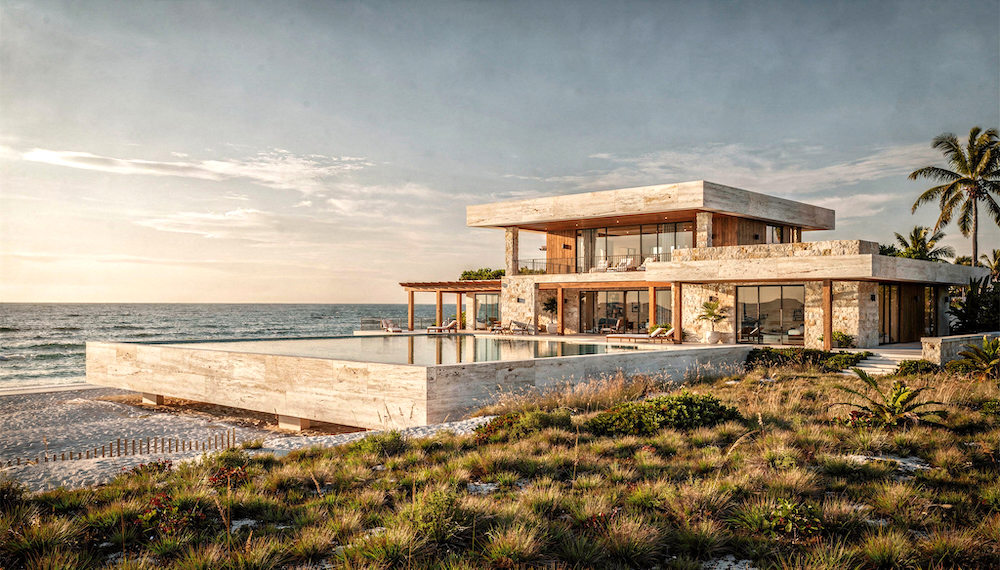
Why Liquidity and Durability Now Define Global Luxury Real Estate
There is a quiet shift underway in global luxury real estate.
It is not dramatic.
It is not disorderly.
And it is not a collapse.
It is a separation.
Across the world, prime residential markets are no longer moving in a single direction. Instead, they are dividing — between property that is truly scarce and property that simply carries a luxury label. Between homes that trade with confidence and those that linger. Between coastal assets that justify their premium and those whose value is being tested.
The defining signal is no longer price alone.
It is liquidity.
And nowhere is this more visible than along the world’s coastlines.
The Illusion of Stability
At first glance, global prime property appears resilient. Many benchmark indices show modest positive growth. A majority of tracked luxury markets continue to record stable or rising nominal values.
Yet nominal appreciation can disguise something subtler.
Over the past decade, headline gains in major markets have been significant. But once inflation is accounted for, the real expansion looks far more measured. Much of the dramatic repricing occurred during 2020–2022, when lifestyle migration, remote work, and historically low financing costs pulled demand toward sunlight, water, and space.
Today’s environment feels different.
Values are not collapsing.
But neither are they accelerating.
We are in a maturity phase.
Liquidity Is the New Signal
In this phase, the most revealing question is not:
“What are prices doing?”
It is:
“How quickly does exceptional property actually sell — and under what terms?”
In prime urban markets such as New York, well-positioned luxury properties continue to transact within weeks or a few months when priced realistically. Negotiation has returned, but distress is rare. Cash buyers dominate at the top end, stabilizing transactions even in a higher-rate world.
Elsewhere, longer marketing periods and wider discounts reflect policy shifts rather than structural weakness. In London, extended repricing tied to taxation and regulatory change has created a buyer-led environment without panic selling.
Liquidity has become postcode-specific.
And in coastal markets, the divergence is even sharper.
The Coastal Premium Is Refining
Coastal real estate does not merely follow urban cycles with a delay. Its drivers are different.
Views are finite.
Water access is finite.
Sunlight, marina infrastructure, protected shoreline — these cannot be reproduced inland.
During the pandemic-era repricing, this scarcity expanded dramatically in value. Palm Beach, Miami, Saint-Tropez, and the Algarve experienced extraordinary multi-year gains. The coastal premium surged as families reprioritized lifestyle.
Much of that expansion has already occurred.
Now, the premium is refining.
It continues to expand for:
• Irreplaceable waterfront
• Architecturally distinctive homes
• Climate-aware, resilient construction
• Serviced, operationally simple residences
It compresses where:
• Development pipelines are heavy
• Branded supply becomes interchangeable
• Insurance costs rise materially
• “Luxury” is abundant rather than scarce
The coast is not weakening.
It is discriminating.
Scarcity Versus Volume
This is the defining divide of the current cycle.
In markets where delivery pipelines are substantial — such as parts of Dubai or resort corridors in Southeast Asia — supply growth can temper liquidity even when demand remains present. More product means longer decision cycles.
In contrast, singular assets — heritage-protected coastlines, irreplaceable compounds, rare penthouses — remain insulated. Their buyer pools are deep, often international, and largely equity-backed.
Luxury is no longer defined by price threshold.
It is defined by replaceability.
Climate and Operational Durability
Another structural shift has moved to the foreground: insurability and resilience.
Global insured catastrophe losses have remained elevated for consecutive years. Insurance premiums, underwriting appetite, and rebuilding timelines are no longer peripheral considerations. They are valuation inputs.
For coastal families, this introduces a new lens:
Beautiful but operationally fragile.
Or beautiful and durable.
In certain Caribbean destinations, positioning outside the hurricane belt has become an explicit differentiator. In parts of Southern Europe and Australia, natural constraints on development reinforce scarcity while also limiting overbuilding.
Durability now carries pricing power.
Branded Residences and the Amenities Era
The rapid expansion of branded residential development has reshaped coastal comparisons. Managed, serviced, and security-oriented residences appeal to families seeking simplicity and multi-hub living.
Premiums are real.
But branding alone is not scarcity.
Where branded supply proliferates, comparability increases. In such settings, liquidity favors the best-located and best-managed product, while secondary inventory can experience longer selling periods.
Service strengthens value when paired with rarity.
It dilutes value when paired with abundance.
Paired Decisions: Coast and Anchor
Few coastal decisions are made in isolation.
They are made in conversation with anchor cities.
Palm Beach and New York.
Costa del Sol and Madrid.
Cascais and Lisboa.
The Athenian Riviera and Athens.
Bodrum and Istanbul.
Phuket and Bangkok.
Strong urban performance can elevate nearby coastlines. Conversely, coastal living can provide stability and lifestyle assurance when urban markets feel politically or fiscally unsettled.
The relationship is no longer cyclical.
It is strategic.
Markets to Watch by Condition
Rather than labeling destinations as “hot” or “cool,” it is more intelligent to understand their structural position.
Stabilizing markets offer liquidity and negotiation balance.
Potentially oversupplied markets offer choice but require discipline and product selectivity.
Structurally resilient markets benefit from constrained supply, diversified demand, and policy clarity.
Emerging opportunity markets often reflect extended repricing or under-recognized coastal adjacency.
The opportunity lies not in chasing momentum — but in understanding condition.
The Coastal Buyer Has Evolved
Across regions, a pattern is clear.
The luxury coastal buyer is increasingly lifestyle-led, but financially disciplined.
She is evaluating:
• Time-to-sell
• Carrying costs
• Insurability
• Energy efficiency
• Service infrastructure
• Multi-hub flexibility
Speculation has given way to selection.
Ease matters. Durability matters. Liquidity matters.
A Market That Is Sorting
The global luxury market is not correcting.
It is separating.
Between durable scarcity and diluted volume.
Between liquidity and stagnation.
Between operational simplicity and hidden friction.
For coastal real estate, the premium still exists.
But it must now be justified — through rarity, resilience, and clarity.
In this phase, liquidity is earned.
And for families building a coastal life, that distinction may be the most valuable signal of all.
Explore More Coastal Intelligence